As an employer, it’s always been important to ensure your payroll data is accurate as it helps super funds match contributions to the right employee and process them without delay.

Under Payday Super, super contributions must generally be received by your employee’s super fund within 7 business days of payday. This makes data quality even more important to help you meet your super obligations.

Correct data helps contributions reach the right employee

To support successful super contributions, you should:

  • keep employee details up to date, including names, dates of birth, tax file number (TFN) and super account details

  • check employee information is accurate before processing payroll

  • work with your payroll or super service provider to resolve data issues promptly

  • review your payroll processes regularly to reduce errors.

Common data errors include:

  • invalid TFN

  • incorrect dates of birth

  • generic values added to employee records.

If the correct information isn’t available for an optional field, leave it blank rather than entering incorrect or substitute data. These data errors can delay the matching and allocation of contributions.

Member verification requests (MVR) reduce errors

An MVR allows you to verify that your employee’s super fund details are correct and that the fund can accept contributions. You can use an MVR:

Although many super funds and self-managed super funds are already responding to MVRs, not all funds are ready. You should check whether your payroll provider or clearing house is ready before sending an MVR. 

How to resolve data errors

If you receive an error message, you should:

  • review the error and follow any instructions from your provider

  • check the employee details are correct, including their name, date of birth, TFN and contact details

  • ask your employee to confirm the details they provided are correct

  • fix any inaccurate or incomplete information before you resubmit it.

You can resolve most issues by fixing this information, so you generally won’t need to contact the fund.

Unresolved data errors can cause the super fund to reject or return contributions. Maintaining accurate payroll data helps funds process and allocate contributions on time. This reduces delays and helps you meet your super obligations.

If you have any questions, give us a call.

Source: ATO
Important: This provides general information and hasn’t taken your circumstances into account. It’s important to consider your particular circumstances before deciding what’s right for you. Although the information is from sources considered reliable, we do not guarantee that it is accurate or complete. You should not rely upon it and should seek qualified advice before making any investment decision. Except where liability under any statute cannot be excluded, we do not accept any liability (whether under contract, tort or otherwise) for any resulting loss or damage of the reader or any other person. Any information provided by the author detailed above is separate and external to our business and our Licensee. Neither our business nor our Licensee takes any responsibility for any action or any service provided by the author. Any links have been provided with permission for information purposes only and will take you to external websites, which are not connected to our company in any way. Note: Our company does not endorse and is not responsible for the accuracy of the contents/information contained within the linked site(s) accessible from this page.


Buying a home may be closer than you think

Buying a home can feel out of reach.

You might be struggling to save a deposit, borrow enough money, or qualify for a home loan. It could be your first time buying a home. Or you may be buying a home again after a major life change like a divorce or separation.

There is no single pathway into home ownership. Government programs, family support and other options may help you overcome different challenges.

The right option depends on what’s stopping you from buying a home.

If you need help with a home deposit

For many people, the deposit is the biggest barrier to buying a home.

This guide to saving for a house deposit can help you create a plan to build your savings. But there may also be options that help you buy sooner.

Buy with a smaller deposit

Some government programs can help you buy a home with a smaller deposit.

These programs may also help you avoid paying lenders mortgage insurance (LMI), which protects the lender if a borrower can’t repay their loan.

Some states and territories also offer low-deposit loan programs:

Get help with the cost of buying a home

If you’re buying or building your first home, you may be eligible for a First Home Owner Grant. Each state and territory has its own rules and grant amounts. The grant can help with the cost of buying or building your home.

Check the First Home Owner Grant website to see what’s available in your state or territory.

Reduce upfront costs

When you buy a home, you may need to pay transfer duty (sometimes called stamp duty). Depending on where you live, you may be eligible for a concession or exemption. This can reduce the amount of money you need upfront when buying a home.

Check what your state or territory offers:

Get help from family

Some buyers get help from family towards a deposit. This could be a cash gift or a guarantor arrangement.

A guarantor uses part of their own property as security for your home loan. In some cases, the guarantee only covers part of the loan, such as the deposit. This can help you buy sooner with a smaller deposit.

A guarantor takes on financial risk if you cannot repay the loan. Make sure everyone understands the arrangement and gets independent legal advice before proceeding.

If you have a deposit but can’t borrow enough

Saving a deposit is only one part of buying a home.

You may have money saved but still find that the amount you can borrow isn’t enough to buy a suitable home.

There may be options that help reduce the amount you need to borrow or increase your buying power.

Reduce the amount you need to borrow

The Australian Government Help to Buy Scheme is a shared equity scheme for eligible home buyers and some people returning to home ownership.

To use the scheme, you’ll need a minimum 2% deposit and a home loan from a participating lender. The Australian Government can contribute up to 30% of the purchase price for an existing home, or up to 40% for a new home. This reduces the size of the loan you need to take out.

In return, the government keeps a share of the property’s value. Eligible first home buyers and some people returning to home ownership can use the scheme.

Minh buys a home sooner with Help to Buy

Minh is 38 and wants to buy a unit close to work.

After several years of saving, he has a deposit of $45,000 and has been approved for a home loan of $550,000.

Together, that gives him $595,000 to put towards the purchase. But the unit he wants to buy costs $845,000.

That leaves a gap of $250,000. Through the Australian Government Help to Buy Scheme, the government contributes $250,000 towards the purchase price of the unit. This reduces the amount Minh needs to borrow and helps him buy a home that would otherwise be out of reach. The smaller loan also means lower repayments.

The government contribution isn’t a grant. Minh will need to repay the government’s share if he sells the property or chooses to buy back the government’s interest in the future. The amount he repays will depend on the value of the property at that time.

This case study is for illustrative purposes. Eligibility rules apply and individual circumstances may differ.

Look for state shared equity programs

Some state governments also offer shared equity programs.

These programs work in a similar way. Another party contributes to the purchase price of the home. This reduces the amount you need to borrow. In return, they receive a share of the property’s value.

Examples of this type of support include:

Buy with someone else

Buying with a partner, family member or friend can increase your buying power by combining income and savings.

Before buying together, agree on ownership, costs and how you’ll make future decisions. A legal agreement can help everyone understand their rights and responsibilities.

Before you apply

Support programs can help you buy a home sooner, but they won’t be right for everyone.

Check whether you are eligible

Each program has its own eligibility rules.

These may cover your income, property value, deposit size, where you want to buy, whether you’ve owned a home before.

Before making plans around a scheme, check that you meet the eligibility criteria.

Consider the ongoing costs of home ownership

Buying a home involves more than a deposit and home loan.

You may also need to budget for:

  • council rates

  • insurance

  • maintenance and repairs

  • body corporate or strata fees

  • utility bills.

Use this mortgage calculator to help estimate the cost of owning a home. Do a budget too, to help work out where all your money is going.

Use this mortgage calculator

Understand what you’re agreeing to

Some options involve ongoing obligations or financial risks.

For example:

  • a shared equity scheme means another party shares in the value of your home

  • a guarantor takes on financial risk if you can’t repay the loan

  • buying with another person means you’ll need to agree on ownership, costs and future decisions.

Make sure you understand what you’re agreeing to before you sign any contracts.

Smart Tip:

You may qualify for more than one type of support. Check all your options before deciding which path to take.

If you are unsure whether you are eligible for any of the grants available, speak to us and we can help you sort out your finances.

Source: Moneysmart
Reproduced with the permission of ASIC’s MoneySmart Team. This article was originally published at https://moneysmart.gov.au/saving/ways-to-buy-a-home-sooner
Important note: This provides general information and hasn’t taken your circumstances into account.  It’s important to consider your particular circumstances before deciding what’s right for you. Although the information is from sources considered reliable, we do not guarantee that it is accurate or complete. You should not rely upon it and should seek qualified advice before making any investment decision. Except where liability under any statute cannot be excluded, we do not accept any liability (whether under contract, tort or otherwise) for any resulting loss or damage of the reader or any other person.  Past performance is not a reliable guide to future returns.
Important: Any information provided by the author detailed above is separate and external to our business and our Licensee. Neither our business nor our Licensee takes any responsibility for any action or any service provided by the author. Any links have been provided with permission for information purposes only and will take you to external websites, which are not connected to our company in any way. Note: Our company does not endorse and is not responsible for the accuracy of the contents/information contained within the linked site(s) accessible from this page.


It was pitched to investors as “the biggest initial public offering (IPO) in a generation”.

Firmus Technologies – a developer of artificial intelligence (AI) data centres – planned to raise A$7 billion from investors on the Australian Securities Exchange.

Recently, bankers working on the deal declared investor interest in the A$11-a-share offer was “well in excess” of what was needed to go ahead.

The company and its backers claimed Firmus was worth almost A$44 billion, which would have made it Australia’s second-largest share market listing, behind Telstra in 1997.

Then, it was off.

What went wrong? And what are the lessons investors should apply to all companies to guard against hype and protect their money?

The warning signs were obvious

There were plenty of red flags ahead of this listing, covered in detail by The Conversation, when the IPO was still meant to be going ahead.

Firmus is losing money. Only two of its data centres are currently operational, with the rest in the planning or construction phase.

Most remarkably, Firmus’ claimed value had soared almost eight-fold in less than a year.

In November 2025, a private funding round valued it at about A$6 billion. In August this year, it had climbed to more than US$10.5 billion (about A$15 billion).

Yet, Firmus declared its value was A$43.7 billion. At that price, Firmus would have been worth almost as much as retail giant Woolworths.

A sign of the market working

The role of the market is to digest a lot of information and price all of that into a reasonable value for each company. If investors believe a company is worth less than its IPO price estimate, they withdraw their interest.

In Firmus’ case, this declining interest from investors seems to be an example of the market working properly.

We never saw a public prospectus with all the details about this listing and Firmus’ financials; it was meant to be released, but it wasn’t.

However, a draft prospectus was being circulated to institutional investors here and overseas. They’ve looked at that – and the prospect of actually committing to buying those shares at A$11 a share – and many have decided “no thanks”.

That’s why the listing was withdrawn.

Look for the incentives behind any claim

As an economist, you always look out for incentives: why would someone say something? What might be in it for them?

There is a clear incentive for investment bankers to ramp up demand before any stock exchange listing. That’s because the higher the float price, the more they pocket, too.

So where did this demand go? It’s quite possible there was strong initial demand for Firmus shares, but it was only indicative. That usually comes down a bit before any listing – or down by a lot, as in Firmus’ case.

Some commentators have raised a more concerning possibility: that the level of investor demand in Firmus may have been misrepresented.

After the Firmus listing was cancelled, The Australian Financial Review reported:

While demand for IPOs can move around, serious questions need to be asked about the sheer scale of the evaporation of orders from investors, or whether the communications were misleading to create the perception of frenzied support. The onus is now on the Australian Securities and Investments Commission to come down hard on those flouting the rules.

We’ll have to see what emerges in coming weeks on this.

Is it a warning sign of an AI bubble?

Investors shouldn’t assume that Firmus’ issues are indicative of every other AI or data centre company.

A lot of this situation is specific to Firmus, including how quickly their quite outrageous valuation numbers ballooned in such a short time.

However, we did see similar things happening during the dot-com bubble a generation ago. Back then, a lot of companies were going public based on “thin air valuations” – projecting huge demand into the future, without the numbers to back it up.

That was echoed in what Firmus was doing now: operating with just 5% of data centre capacity up and running, while the remaining 95% they were talking about as underpinning their valuation hadn’t yet been built.

What are the lessons for investors?

Potential investors should look at the hard numbers as closely as they can.

If you can’t find out what a company’s revenue was in the past year, and where it expects its money will be coming from for the next five years, at least – that’s a red flag.

Of course, even if you have those figures, that doesn’t mean things won’t go wrong down the road. But understanding those key numbers is a must, before you ever invest.

The golden rules are to diversify your investment portfolio and try to minimise your fees. And if you are buying into a single company’s IPO, it’s safer to allocate limited amounts to those.

As a general rule: don’t invest in single stocks more than you can afford to lose.

Source: This article is republished from The Conversation

Key events in October 2026

  • Global shares fell modestly in October. Concerns over the potential escalation of the Iran War, the US Congressional election result in November, as well as the rapid acceleration in Artificial Intelligence (AI) capital investment and corporate borrowing, have made investors more cautious.

  • US share prices achieved historic highs in early October given optimism on AI prospects and encouraging US corporate profit results. US corporates are set to deliver astonishing annual profit gains exceeding +30% in the September quarter according to FactSet. Large technology companies continue to rapidly increase their AI capital investment which is also supporting economic activity. However, corporate credit spreads are widening given the AI capital spending boom. The US central bank is also warning that interest rates may be raised given that “inflation remains elevated.”

  • Asian share markets delivered a weaker performance. Japanese, Korean and Taiwanese shares fell with more caution on future AI demand for computer chips. Chinese shares slumped with continued subdued results for consumer spending and the housing market.

  • Australian shares made mild gains in October. The Utilities, Financial and Health Care sectors made very strong gains with investors becoming more defensive on Australia’s prospects. However, there were sharp declines in the Resources sector, weighed down by lower global iron ore and gold prices. The Information Technology sector also declined sharply, continuing its weak performance this year.

  • Australia’s inflation data was again disappointing which has compelled the Reserve Bank of Australia (RBA) to raise interest rates in November. Australia’s headline annual inflation climbed to 4.3% in September which is well above the central bank’s 2% to 3% target range. There were also subdued results for both household spending data and the unemployment rate, which climbed to 4.7% in September.

Asset class summary

Asset class returns in Australian dollars – periods to 31 October 2026


CYTD

%

1 month

%

3 months

%

1 year

%

3 years

pa %

5 years

pa %

10 years

pa %

Australian shares

4.5

1.1

0.3

3.1

13.2

7.7

9.3

Global shares (hedged)

11.7

–1.4

0.2

12.7

21.4

9.9

11.9

Global shares (unhedged)

5.4

-2.7

-0.3

4.5

18.1

11.6

13.3

Emerging markets (unhedged)

7.5

–9.1

–5.6

6.1

18.1

8.3

9.0

Global property securities (hedged)

5.6

2.4

-6.1

6.2

11.2

-0.1

3.1

Global listed infrastructure (hedged)

12.0

7.7

0.5

13.2

15.4

6.7

7.3

Australian bonds

1.9

1.2

0.1

0.4

4.6

1.0

1.8

Global bonds (hedged)

0.5

1.8

0.2

0.4

4.5

–0.1

1.4

Global high yield bonds (hedged)

1.1

0.6

-0.8

2.3

7.4

2.5

4.1

Australian inflation-linked bonds

3.5

1.3

0.6

2.0

4.4

3.0

2.9

Cash

3.5

0.4

1.1

4.1

4.2

3.4

2.3

AUD/USD

5.5

1.1

0.2

7.5

3.6

–1.3

–0.8

Past performance is not a reliable indicator of future performance.

Sources: Australian shares – S&P/ASX 300 Total Return Index; Global shares (hedged) – MSCI All Countries World (A$ hedged, Net); Global shares (unhedged) – MSCI All Countries World in A$ (Net); Emerging markets – MSCI Emerging Markets in A$ (Net); Global property securities – FTSE EPRA/NAREIT Developed (A$ hedged, Net); Global listed infrastructure – FTSE Global Core Infrastructure 50/50 (Hedged $A); Australian bonds – Bloomberg AusBond Composite 0+ Yr Index; Global bonds (A$ hedged) – Barclays Global Aggregate (A$ hedged, Gross); Global high yield bonds (A$ hedged) – Barclays US High Yield Ba/B Cash Pay x Financials ($A Hedged); Australian inflation-linked bonds – Bloomberg AusBond Inflation Government 0+ Yr Index; Cash – Bloomberg AusBond Bank Bill Index; AUD/USD – WM/Reuters Daily (4 pm GMT).

Key events in global markets over the last three months to October 2026

Global shares (hedged) made a flat quarterly return of 0.2%. Optimism on AI has been challenged by rising bond yields and energy prices over recent months. The brief ceasefire between Iran and the US collapsed in July with the resumption of military strikes and another closure of the Strait of Hormuz as a shipping route.

While global shares have shown remarkable resilience to events in the Middle East this year, this strength is now being tested as the Iran War intensifies again. Wall Street has been a key source of strength by making historic highs. Yet this strength is counterbalanced by sharp weakness in Asian and European share markets. Chinese shares have been a disappointment with a very weak -11.8% return for the MSCI index in local currency terms.

Global bonds (hedged) posted a sedate 0.2% quarterly return. Concerns over the inflation risk with rising energy prices and persistent government deficits have generated sharp rises in global bond yields this year. Australian bonds have also struggled with the inflation threat by recording a subdued 0.1% quarterly return.

Key events in Australia over the last three months to October 2026

Australian shares made a mild 0.3% quarterly return, but this was a mixed performance across industry sectors. Some of the sectors that were beaten down earlier this year have made a recovery over recent months. The Health Care sector made a remarkable revival with a 29.6% quarterly return as investors considered that Cochlear and CSL had become cheap. There were also strong gains for the Energy sector given the surge in oil and gas prices with the Middle East conflict.

However, there were large share price declines in a range of sectors exposed to the threat of higher interest rates and a consumer spending slowdown. The Real Estate sector fell sharply by -6.9%.

Australia’s economy is confronting significant challenges given persistent high inflation and rising interest rates. Consumer spending is slowing as the ‘cost of living’ squeeze continues. Housing prices are falling sharply given higher mortgage interest rates as well as the Federal Government’s major changes to capital gains tax and negative gearing in May.

Australia’s high inflation remains troubling and has motivated the RBA to raise interest rates in both September and November. Persistent price pressures remain prominent in a wide range of goods and services. Housing costs have increased by 5.2% over the past year given rising electricity prices (12.8% annual inflation), new dwelling construction costs (4.7% annual) and rents (3.6%). Healthcare costs have risen by 3.7% and education has increased by 4.7% in the past year.

Global prospects

Financial markets are trying to find a balance between hopes that AI will drive strong economic growth and corporate profitability and the harsh reality that Eastern Europe and the Middle East are in turmoil.

The recent escalation of the Iran War and the Russia-Ukraine War presents a severe challenge for the global economy. Shipping costs have surged while there is limited spare capacity in fuel refineries around the globe to produce sufficient diesel and petrol supplies. If this energy shock escalates further, the pain will spread as both inflation and unemployment could dramatically rise. Central banks would then confront a major challenge in their decision making. Do central banks raise interest rates to restrain inflation pressures or lower interest rates to assist economic activity and mitigate rising unemployment?

Regrettably, major central banks seem set to raise interest rates further to address the immediate inflation threat. The US central bank joined its fellow counterparts in Europe and Japan by raising interest rates in September. Bond markets are now pricing in a sequence of further interest rate rises across the globe to address inflation risks. Global share markets could then prove vulnerable should interest rates rise sharply.

Australia’s persistent price pressures in food, health and housing continue to squeeze budgets. This “cost of living” squeeze is likely to weigh heavily on consumer spending over coming months. Lower house prices will also caution some consumers on their spending.

Given these complex risks, investors should maintain a disciplined and diversified strategy.

Important information This communication is provided by MLC Investments Limited (ABN 30 002 641 661, AFSL 230705) (MLC), part of the Insignia Financial Group of companies (comprising Insignia Financial Ltd, ABN 49 100 103 722 and its related bodies corporate) (‘Insignia Financial Group’). An investment with MLC does not represent a deposit or liability of, and is not guaranteed by, the Insignia Financial Group. This information may constitute general advice. It has been prepared without taking account of an investor’s objectives, financial situation or needs and because of that an investor should, before acting on the advice, consider the appropriateness of the advice having regard to their personal objectives, financial situation and needs. Past performance is not a reliable indicator of future performance. Share market returns are all in local currency. Any opinions expressed in this communication constitute our judgement at the time of issue and are subject to change. We believe that the information contained in this communication is correct and that any estimates, opinions, conclusions or recommendations are held or made as at the time of compilation. However, no warranty is made as to their accuracy or reliability (which may change without notice), or other information contained in this communication. This information is directed to and prepared for Australian residents only. MLC may use the services of any member of the Insignia Financial Group where it makes good business sense to do so and will benefit customers. Amounts paid for these services are always negotiated on an arm’s length basis. MLC relies on third parties to provide certain information and is not responsible for its accuracy, nor is MLC liable for any loss arising from a person relying on information provided by third parties. Bloomberg Finance L.P. and its affiliates (collectively, “Bloomberg”) do not approve or endorse any information included in this material and disclaim all liability for any loss or damage of any kind arising out of the use of all or any part of this material. The funds referred to herein is not sponsored, endorsed, or promoted by MSCI, and MSCI bears no liability with respect to any such funds.

Key Points

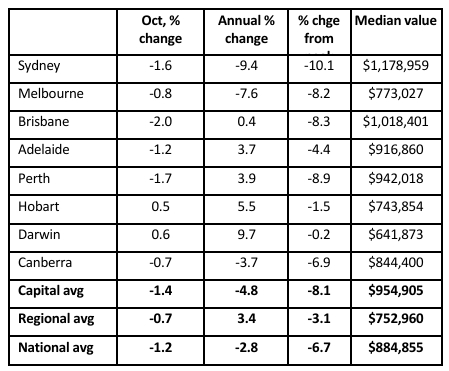
  • The slump in national average home prices continued in October with prices down another 1.2% according to Cotality, their seventh monthly fall.

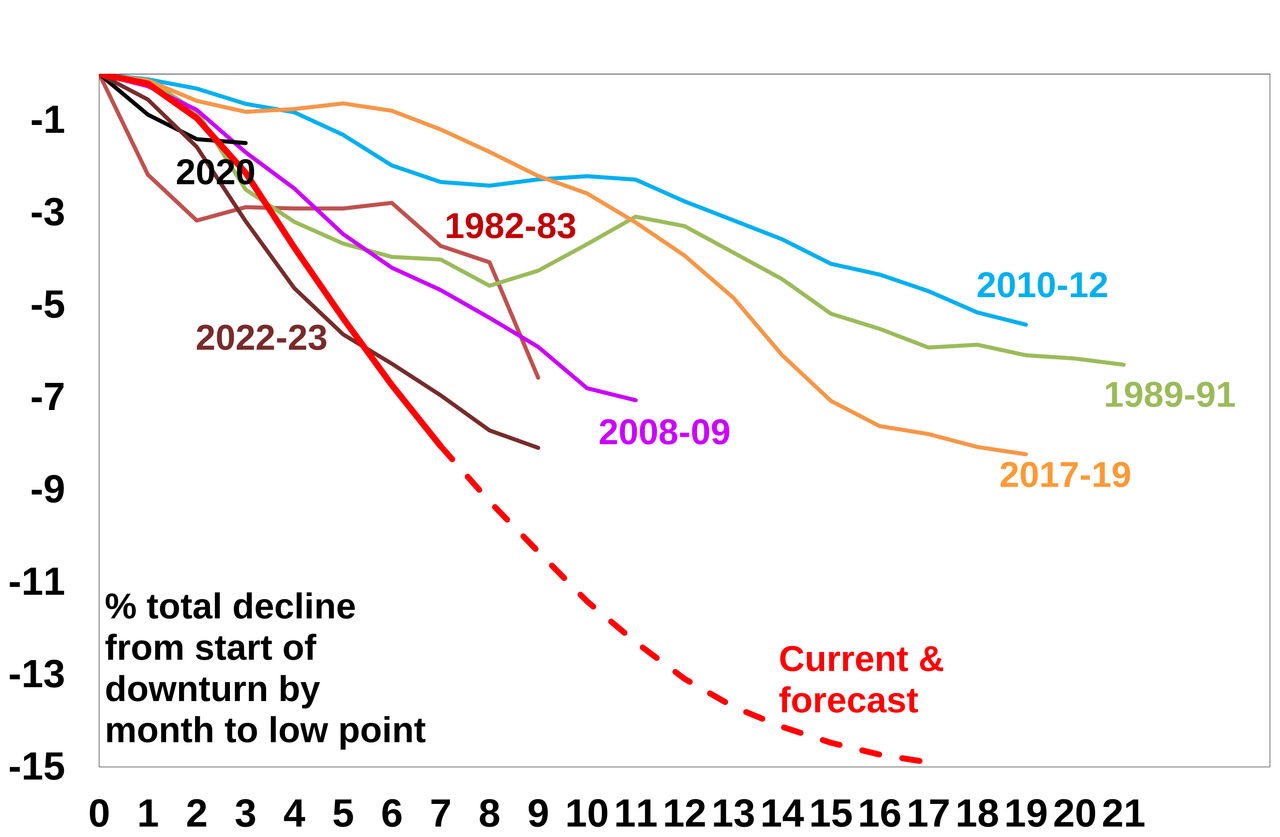
  • The rapid decline, more rate hikes than expected and rising unemployment combined with the structural change associated with the tax hikes on investors suggest that the top to bottom fall is now likely to be around 15%.

  • Prices aren’t expected to bottom until around the September quarter next year and should start a modest recovery in 2027-28 as the RBA shifts to rate cuts.

  • The home price slump will weigh on economic growth via negative wealth effects, but it’s not significant enough yet for the RBA to shift gears toward cutting rates given high inflation is the more pressing problem. But it likely will be by the second half next year.

Introduction

Cotality data shows national average home prices fell 1.2% in October, with capital city prices down 1.4%.

Source: Cotality

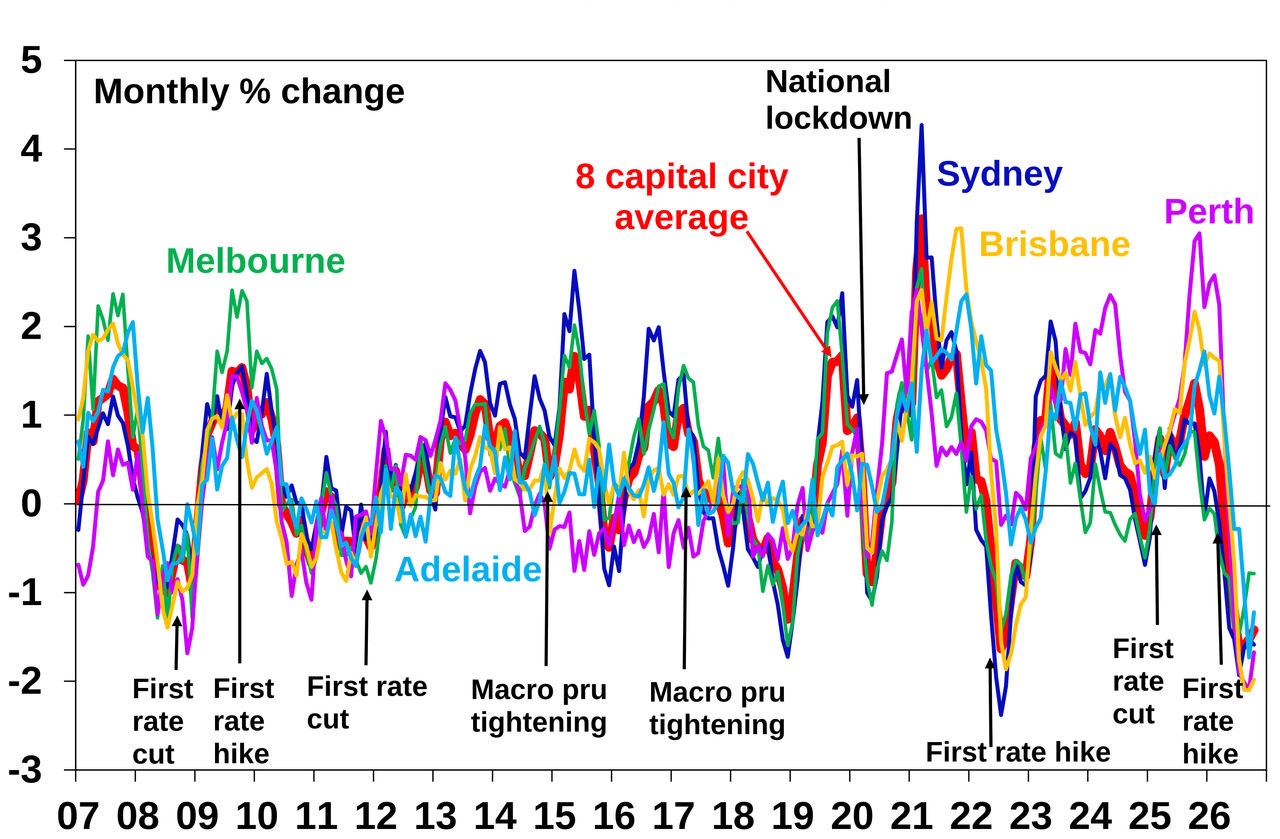
The downturn reflects a perfect storm for the property market of rate hikes, the Budget tax hikes on investors, poor affordability and poor buyer confidence. These are swamping the still positive influences coming from the chronic shortage of housing in Australia and the boost from the expansion of the 5% low deposit scheme for first home buyers. Note that while the pace of decline looks to be slowing in the next chart, recent months continue to be revised down, and October is likely to be too.

Average capital city home prices

Source: Cotality, AMP

Prices nationally have now fallen 6.7% from their high in March, with Sydney leading the fall with a 10.1% drop. While national average property prices are still up nearly 50% this decade, average dwelling prices in Melbourne have fallen back to around early 2021 levels and those in Sydney are back to around late 2021 levels.

The perfect property storm has further to go

The Australian housing market is likely to weaken significantly further for several reasons:

  • The pressure from rate hikes is intensifying with the RBA having already hiked four times this year and looking like it will hike again this week taking the cash rate to its highest in 18 years.

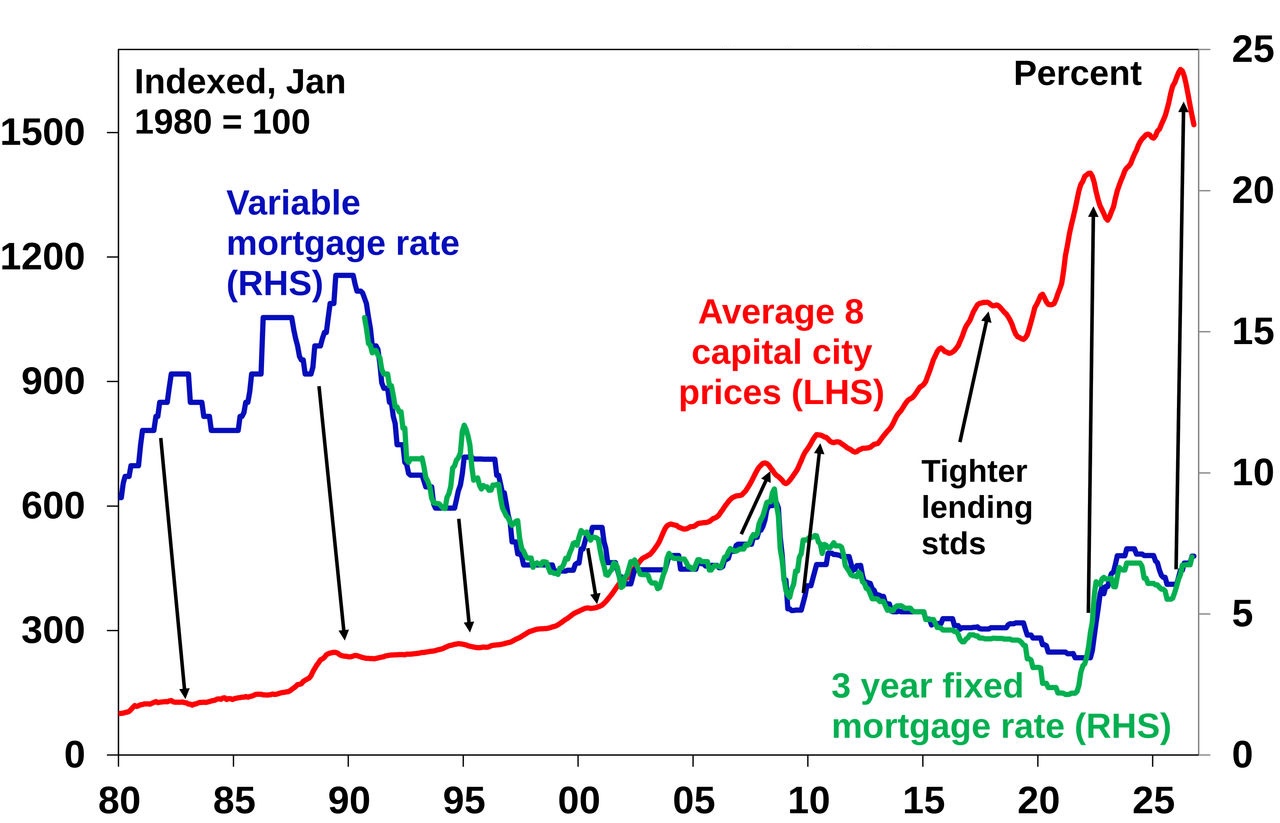
    • Rate hikes are usually associated with weaker property prices and this cycle is proving to be no exception. This is because they cut how much buyers can borrow, can boost distressed sales and hit home buyer confidence.

      Interest rate hikes and property prices

      Source: Cotality, RBA, AMP

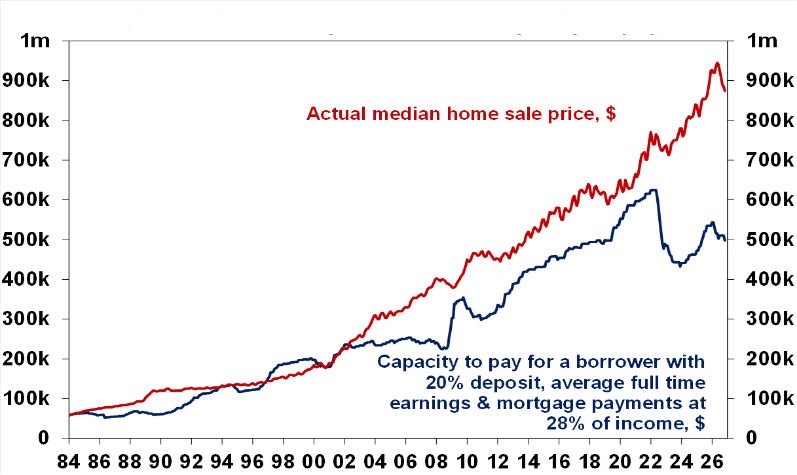
    • Each 0.25% rise in rates knocks around $11,000 off the amount that an in individual buyer on average earnings with a 20% deposit can pay for a home, so the four rate hikes seen already this year mean a total hit to their capacity to pay of around $45,000. This is occurring at a time when poor housing affordability, ie the surge in home prices relative to wages and household incomes to record levels, had already led to a $400,000 or so gap between home prices and the capacity to pay for a home.

      Australian home prices versus capacity to pay

      Source: Cotality, ABS, AMP

    • The drip feed of higher rates will also put more pressure on existing homeowners already suffering from mortgage stress. Another rate hike this week will mean roughly an extra $110 a month in mortgage interest payments for mortgage holders and a total increase of $550 a month since January or $6600 year – which runs the risk that we may be close to a tipping point for some mortgage holders. The weaker jobs market and rising unemployment risks also adding to distressed sales.

    • While we think the RBA after another rate hike this week will have done enough to slow demand in the economy to cool inflation, the risk of further hikes is high and in any case RBA commentary is likely to continue to lean hawkish warning of more hikes to come for a while yet and we don’t see it cutting rates until the December quarter next year.

  • The Budget tax hikes on investors – the move to curtail access to negative gearing and return to the taxation of real capital gains is continuing to drive a big decline in investor demand for residential property in the near term because it means a significantly lower after-tax return for investors.

  • Poor buyer confidence –consumer confidence is running around levels often associated with recession.

With price falls now the most rapid on record since 1980, average prices already down 6.7% with no loss of negative momentum, the drags on demand set to continue for a while yet and a likely rise in distressed selling, we are revising our expected top to bottom fall to around 15%. This is deeper than the range of average capital city property price declines seen over the last 40 years or so but is consistent with the perfect storm now hitting the property market. However, by the September quarter next year, property prices are likely to bottom with the market starting to anticipate RBA rate cuts.

Australian capital city home price downturns

Chart refers to average prices for the eight capital cities. Source: Cotality, ABS, AMP

More signs of the end of the 30-year super cycle

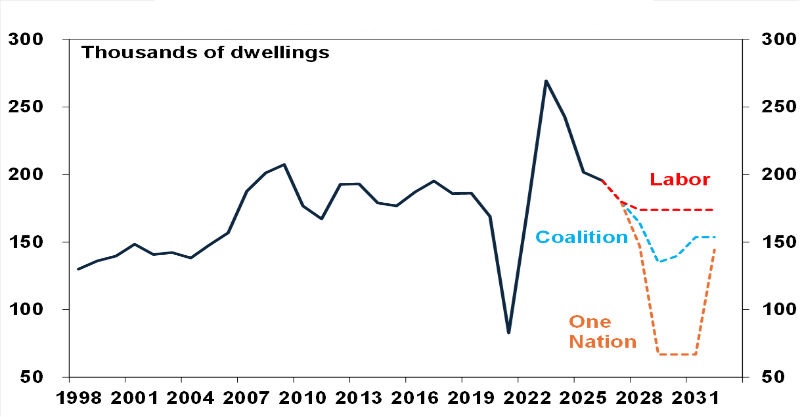
The combination of a rising long-term trend in mortgage rates after the long term downtrend that ran from 1989 (when they peaked at 17%) to 2021 (when they bottomed around 2%), the virtual removal of property tax concessions, record poor affordability and a political shift towards lower immigration after nearly 20 years of relatively high immigration may mean the 30-year super cycle upswing in home prices may be over. This saw average property prices rise dramatically faster than their long-term trend and incomes since the mid-1990s and led to chronically poor housing affordability. Of course, the ongoing housing shortage remains – which could be made worse by having less investors involved in the property market – and is the key sticking point, so it’s hard to be definitive! That said, Coalition and One Nation policies for a sharp pull back in immigration levels imply sharply lower underlying demand for housing if they attain power.

Australia: Housing Demand Estimates

Charts shows forward estimates of underlying housing demand. Source: ABS, AMP

The property price downturn and the economy

There are several implications for the economy:

  • A drag on consumer spending – with each 10% fall in home prices likely to knock around 1% off consumer spending as people feel less wealthy. This is likely to be increasingly evident in the months ahead.

  • Less new home building – as established dwelling prices fall relative to new dwellings reducing the incentive to build new homes.

  • Increased negative equity – where a homeowner’s mortgage debt is worth more than their home. This is low at present and is really only an issue (beyond the wealth effect) if the homeowner has to sell. But it will impact those who bought say around the end of last year.

  • Rising bank bad loans and less demand for credit – the former is not a major problem for the banks as they have significant capital reserves but the latter has been weighing on their share prices.

At a high level this means that the home price downturn will mean an increasing drag on economic growth and demand in the economy. So far, the fall in prices – considering that they are still up nearly 50% so far this decade – has still not been enough to offset the problems the RBA faces around excessive inflation. However, if the property price downturn continues into next year it will likely eventually become a factor in capping rates and the RBA pivoting towards rate cuts later next year.

What to watch?

The key things to watch will be interest rates, consumer confidence, unemployment and investor demand. More rate hikes, a sharply rising trend in unemployment and a further drying up in investor demand could result in bigger price falls than the 15% fall we are now expecting. Alternatively an earlier move to RBA rate cuts could see the property market bottom out earlier than the September quarter next year.

What does it mean for share markets?

The experience of the last 35 years suggests that while first Fed rate hikes in a tightening cycle can cause a dip in shares, the bull market usually resumes until rates become onerously tight, which weighs on profits. This can be seen in the next chart. US shares had wobbles when rates first started to move up in February 1994 (US shares had a 9% correction), in June 2004 (US shares had an 8% correction) and in December 2015 (US shares had a 13% correction) but thereafter they resumed their rising trend and a bear market did not set in till 2000, 2007 and 2020 after multiple hikes. Of course, the 2020 bear market was ostensibly due to the pandemic. Recession did not come for seven years after the February 1994 first hike, for three and a half years after the June 2004 first hike and for four years after the December 2015 first hike. This is because the first rate hike only takes monetary policy to less easy, and it’s only when monetary policy becomes tight that the economy gets hit. The start of Fed tightening in the last cycle in March 2022 was different as shares were already in a falling trend and this continued until October 2022 culminating in a 25% fall. But inflation was much higher then – with US core CPI inflation of 6.5%yoy when the Fed started to hike necessitating a more aggressive increase in interest rates whereas now it’s much lower.

Dr Shane Oliver – Head of Investment Strategy and Chief Economist, AMP
Important note: While every care has been taken in the preparation of this document, AMP Capital Investors Limited (ABN 59 001 777 591, AFSL 232497) and AMP Capital Funds Management Limited (ABN 15 159 557 721, AFSL 426455) make no representations or warranties as to the accuracy or completeness of any statement in it including, without limitation, any forecasts. Past performance is not a reliable indicator of future performance. This document has been prepared for the purpose of providing general information, without taking account of any particular investor’s objectives, financial situation or needs. An investor should, before making any investment decisions, consider the appropriateness of the information in this document, and seek professional advice, having regard to the investor’s objectives, financial situation and needs. This document is solely for the use of the party to whom it is provided.

At its meeting today, the Board decided to increase the cash rate target to 4.85 per cent. This is the fifth increase this year, taking the cash rate to its highest level since 2008.

Inflation remains elevated and recent data indicate that it is broadly based. The inflation outlook has also been revised materially higher in the updated staff forecasts.

This partly reflects higher fuel and other commodity prices affected by the conflict in the Middle East. But domestic capacity pressures are also judged to have been a little tighter than earlier thought.

Please click here to view the Statement by the Monetary Policy Board: Monetary Policy Decision.

Please get in touch if you would like to discuss recent rates and how they may affect you, or if you would like to review your finance options.

Share markets and property dominate most investment conversations, but some investors are casting a wider net in search of new opportunities.

While alternative assets have long had a place in institutional portfolios, they’re becoming increasingly accessible to individual investors through managed funds, exchange traded funds (ETFs) and specialist investment vehicles.

Alternative assets can include infrastructure, agricultural investments, private credit, commodities and other investments whose performance may not closely follow traditional share markets.

For many investors, the appeal lies in the potential for more diversification, inflation protection and exposure to long-term structural trends.

As always, alternative investments come with their own risks and should be assessed against your overall financial goals, time horizon and tolerance for risk.

Powering the AI revolution

Artificial intelligence has become one of the dominant investment themes of the decade, but many are looking beyond software developers and technology companies to the infrastructure supporting the AI boom.

The increasing use of AI, cloud computing, streaming services and digital communications is driving unprecedented demand for data centres, fibre-optic networks and communications infrastructure. Global investment in data-centre capacity and AI infrastructure continues to accelerate as organisations require greater processing power and data storage capabilities.i

Today, digital infrastructure is as essential to modern economies as roads, railways, ports and electricity networks were in previous generations. Many of these assets generate long-term contractual revenue streams and may provide a degree of stability compared with more volatile sectors.

Investors are increasingly seeing digital infrastructure as a way to get exposure to long-term growth without relying solely on technology company share prices.

But the sector is not immune from risk. Rapid technological change, regulatory developments, high capital costs and growing energy demands all have the potential to influence future returns.

Agriculture feeding long-term growth

Agriculture continues to attract investor attention because it is linked to one of the world’s most fundamental needs: food production.

Population growth, rising incomes and changing dietary patterns are expected to support demand for agricultural products and food supply chains. International organisations continue to highlight the significant investment required to support future agricultural production and food security.ii

Agricultural assets can include farmland, water entitlements, agricultural infrastructure and businesses involved in food production.

Agriculture also has characteristics that differ from many traditional investments. Returns can be influenced by crop production, commodity prices, land values and global food demand rather than share market sentiment alone.

That said, agriculture is far from risk-free. Droughts, floods, changing weather patterns, biosecurity threats and geopolitical uncertainty can all affect profitability. Government policies, trade agreements and international tariffs also have the potential to significantly influence outcomes.

Despite these challenges, investors see quality agricultural assets as a potential source of diversification and long-term value.

Private credit stepping into the gap

Private credit has emerged as another area attracting attention. Rather than lending through traditional banks, private credit funds provide financing directly to businesses, property developments and other projects.

The sector has grown significantly in recent years as tighter banking regulations and changing lending conditions have encouraged many borrowers to seek alternative sources of capital.iii

Private credit can provide access to income streams that may differ from those generated by traditional bonds or listed shares.

However, this can be less liquid than listed investments and may involve higher risk if borrowers experience financial difficulties.

Critical minerals powering the energy transition

The global shift towards renewable energy, battery storage and electrification has also increased investor interest in critical minerals. Materials such as lithium, copper, nickel and rare earth elements are essential components in electric vehicles, batteries, renewable energy systems and modern technology.

Demand forecasts continue to be influenced by investment in clean energy infrastructure and the ongoing electrification of transport and industry.iv

However, critical minerals can be highly cyclical investments. Prices may be affected by changing technology, shifts in supply and demand, government policies and geopolitical developments.

The sector can offer significant growth potential but may also be highly volatile.

Emerging markets creating new opportunities

Some investors are also looking beyond developed economies in search of future growth opportunities.

Emerging economies such as India, Vietnam and Mexico have attracted increasing attention due to strong economic growth, expanding middle-class populations, growing consumer spending and increasing participation in global manufacturing and supply chains.

International forecasts suggest many emerging economies will contribute a significant share of future global growth.v

Supply-chain diversification has also created opportunities for a number of countries looking to attract manufacturing investment from multinational businesses.

Investment in infrastructure, telecommunications and digital connectivity may support future growth across parts of Africa, Asia and Latin America.

Emerging markets can offer attractive growth potential, but these opportunities are often accompanied by extra risk. Political instability, regulatory changes, currency movements and weaker governance frameworks can create higher levels of volatility.

As a result, emerging markets should be considered as part of a diversified investment strategy, rather than as a concentrated investment position.

Finding the right balance

Alternative investments can offer valuable opportunities to diversify sources of return and get exposure to long-term global trends. Sectors such as digital infrastructure, agriculture, private credit, critical minerals and emerging markets each present different opportunities and risks, making careful research essential.

While alternative assets may enhance diversification, they should not be viewed as a substitute for a well-balanced investment portfolio. Successful investing remains focused on aligning asset allocations with personal objectives, investment timeframes and risk tolerance.

For investors willing to look beyond traditional asset classes, alternative investments may provide another way to participate in some of the most significant economic and technological trends shaping the future.

i PwC | Global investment in AI infrastructure
ii
UN | Food and Agriculture Organization
iii
PwC | Private Credit Survey 2026
iv
IEA | Global Critical Minerals Outlook 2026
v
IMF | World Economic Outlook

“How much do you earn?”  “Do you have any debts?” 

“How long have you been with your current employer?” 

At times, applying for a loan can feel less like a conversation and more like an extremely detailed interrogation. You might wonder whether we are helping you to secure finance or having a good old ‘sticky beak’ into your private financial affairs. 

You may be reassured to learn there is a reason behind every question we ask and every document we request. The intense interest in your financial life is because understanding your full financial position helps us find the right lending option for you. 

We need the full picture, not just the headline 

When people first come to us, they often start with the key details: “I earn this much, I want to borrow this much, and I have found this property.” 

Those details are important, but they are only part of the story. 

Lenders assess more than just your income and borrowing amount. They look at your expenses, existing commitments, financial history and overall position. A loan that appears suitable at first glance may not always be the best fit once all the details are considered. 

That is why we ask questions that reveal the full extent of your financial situation. Understanding the bigger picture helps us identify opportunities, anticipate potential challenges and find lending solutions that align with your goals. 

The aim is not simply to get a successful application approved. It is to help structure your finance in a way that works for your circumstances, both now and into the future. 

The considerations behind the questions 

Some questions may seem unrelated to getting a loan, but they help us understand what you are trying to achieve. 

Are you planning to start a family? 
Do you expect your income to change? 
Are you thinking about buying an investment property in the future? 
Do you want the flexibility to make extra repayments? 

These questions are not about making the process more complicated. They help us look beyond today and consider whether a loan will continue to support your goals over time. 

The lowest interest rate is not always the best loan if it does not provide the flexibility, features or structure you need. 

Yes, we really do need those documents 

Nobody gets excited about paperwork. We understand that gathering payslips, bank statements and supporting documents can feel like a chore. 

However, those documents play an important role in building a strong application. They provide evidence of your financial position and allow us to present your circumstances clearly to lenders. 

We are looking for opportunities, not problems 

A common misconception is that we are looking for reasons why an application will not work. The reality is the exact opposite. We are looking for ways to make your goals achievable. 

If there are challenges in your financial position, knowing about them early gives us the opportunity to explore solutions. It might mean improving your application before submitting it, finding a lender with more suitable policies or considering different loan structures. 

The more information we have, the more options we can explore. 

Why honesty helps your application 

It can be tempting to leave out small details because you assume they are not important or even try to cover up things you think won’t be viewed positively by lenders. However, surprises are rarely helpful during the lending process. 

Whether it is an existing debt, a change in income, upcoming plans or a financial commitment, having the full picture from the beginning allows us to provide better advice and avoid unexpected issues later. 

Our role is not to judge your circumstances. It is to understand them and work with you to find the best possible path forward. 

The more we know, the more we can help 

While you can avoid a lot of onerous paperwork with a broker, there is no getting around the fact that you need to provide information to support your application.  

Just remember when you feel like you are getting grilled, we need to get a good understanding of your financial position and goals to help make the process as painless and efficient as possible for you and get the right loan for your circumstances.  

Many business owners don’t tend to think about getting a formal valuation until they’re preparing to sell. But proposed capital gains tax (CGT) changes, due to commence from 1 July 2027, may mean valuations become important even when a sale is years away.i

Business owners may wish to establish the market value of relevant assets and business interests as at 1 July 2027 in order to support future CGT calculations.

Even if you have no immediate plans to sell, maintaining accurate records and supporting documentation may help achieve better tax outcomes.

What are the new CGT rules?

From 1 July 2027, the existing 50 per cent discount for capital gains available to individuals, trusts and partnerships will be replaced by cost base indexation and a 30 per cent minimum tax rate.ii

The new regime will apply to all capital gains accrued from 1 July 2027 (subject to limited exemptions).

Depending on your circumstances, relevant assets may include shares in a private company, business premises, goodwill, investment assets and other interests subject to the CGT rules. Professional advice may be required to determine which assets are affected.

Business owners need to consider what records and information will be required to substantiate the market value of relevant assets and business interests at that date. These will be needed when a capital gain is crystallised in the future.iii

Supporting information

The ATO publication Market Valuation for Tax Purposes outlines the information it requires for a valuation and this is more than a simple monetary value.

An acceptable valuation needs to be objective and independent, based on recognised valuation methodologies and be supported by credible evidence. It must include details of the asset being valued, the date it was valued and clear records to explain the basis for the market valuation.

Valuations prepared by qualified professional valuers are generally regarded as more credible by the ATO and may provide greater protection where reasonable care has been taken and accepted valuation methodologies have been applied.

Advantages of a formal valuation

Obtaining a professional valuation can help to provide greater certainty regarding potential tax liabilities and may assist with future decisions about when and how assets are ultimately sold.

Subsequent accrued capital gains are subject to the new indexation and minimum tax rate.

If you choose not to establish a market valuation for your business assets, a prescribed formula will apply, which could result in more capital gain being attributed to the post 1 July 2027 period.iv

Act now or wait?

For many business owners, obtaining a formal valuation prior to or immediately after 30 June 2027 may not be necessary, as retrospective valuations can be prepared. However, you still need to gather and retain sufficient information so a professional valuer can reconstruct and support a valuation in the future.

If you anticipate a business sale, succession event, significant transaction or ownership restructure in the near future, it may be sensible to obtain a valuation close to 1 July 2027.

Other situations where a valuation may be warranted include a business with complex valuation considerations, shareholders who want certainty regarding future tax outcomes, or if your business has the size, value or industry profile of interest to the ATO.

Preparing your business for valuation

A supportable business valuation will require the collation of financial statements and management accounts, bookkeeping files and fixed asset registers for at least three years to 30 June 2027. Budgets, forecasts, business plans, project pipelines and relevant assumptions or working papers will also be required. The quality and completeness of these records can significantly influence the strength and reliability of a future valuation.

Valuers will also need information about employee entitlements, sales breakdown by client, abnormal income and expenses, and agreements with key customers and suppliers.

Your shareholder and ownership records, acquisition documents and board papers also need to be compiled.

Obtaining a current market valuation is not just about the new CGT rules. It can also provide valuable insights into your business, help with goal setting and could make obtaining finance easier

 i ATO | Reforming negative gearing and capital gains tax
ii ATO | CGT discount
iii ATO | Market valuation of assets
iv Budget 2026-27 | Tax Explainer

What is your ‘estate’?

Your ‘estate’ includes everything you own – your ‘earthly possessions’, if you will. It can include for example cash, property, cars, boats, furniture, jewellery, family heirlooms, art, shares and more.

What is estate planning?

This is where you decide what will happen to your belongings after you pass away. By leaving a clear set of ‘instructions’, you help make sure that the people you care most about aren’t faced with any unnecessary conflict or uncertainty.

Why is estate planning important?

Even if you don’t have much money or property, planning your estate is the best way to make sure that special belongings go to the people who will treasure them. Often, it’s these items that matter most.

Why an estate plan is a good plan

  • Your assets get passed on to beneficiaries that you choose. If you pass away without a valid will (and in turn, without a valid estate plan) you’re considered to have ‘died intestate’ and your assets get distributed according to your state’s inheritance laws—not your wishes.
  • If you leave kids behind, you decide who cares for them and how—not the courts.
  • You minimise the tax your beneficiaries may pay when they inherit your assets.
  • You reduce the risk of conflict between family and friends when you pass away.

What’s in your will?

Your will is a legal document that’s part of your estate plan. It outlines how you want your estate to be managed and how you want your assets to be distributed when you pass away.

If you have a fairly straightforward estate and know how you’d like to distribute it, you can easily write your will yourself. It’s as simple as buying a will pack from Australia Post and select news agencies, or downloading it online.

For more complicated estates, it might be a good idea to get advice from a solicitor or the Public Trustee. You can then appoint them to be your executor.

Your will checklist

Your will should:

  • clearly identify your beneficiaries
  • clearly identify your executor
  • have the right date on it
  • be signed correctly
  • be witnessed correctly
  • list exactly how you want your estate to be distributed to your beneficiaries (including any plans if they pass away before you)
  • be up to date.

Should you review your estate plan?

Life is never predictable, so it’s a good idea to update your estate plan when things change.

Why you might change your estate plan

  • You get married.
  • You get divorced.
  • You have kids.
  • Your partner, dependant or loved one passes away.
  • You experience financial hardship.

Other things to consider

Organising life insurance and a funeral plan can make things easier for your family later. Learn the ins and outs of life insurance, or find out about estate planning in more detail with ASIC’s Moneysmart guide.

Source: NAB
Reproduced with permission of National Australia Bank (‘NAB’). This article was originally published at https://www.nab.com.au/personal/life-moments/family/will
National Australia Bank Limited. ABN 12 004 044 937 AFSL and Australian Credit Licence 230686. The information contained in this article is intended to be of a general nature only. Any advice contained in this article has been prepared without taking into account your objectives, financial situation or needs. Before acting on any advice on this website, NAB recommends that you consider whether it is appropriate for your circumstances.
© 2026 National Australia Bank Limited (“NAB”). All rights reserved.
Important:
Any information provided by the author detailed above is separate and external to our business and our Licensee. Neither our business nor our Licensee takes any responsibility for any action or any service provided by the author. Any links have been provided with permission for information purposes only and will take you to external websites, which are not connected to our company in any way. Note: Our company does not endorse and is not responsible for the accuracy of the contents/information contained within the linked site(s) accessible from this page.